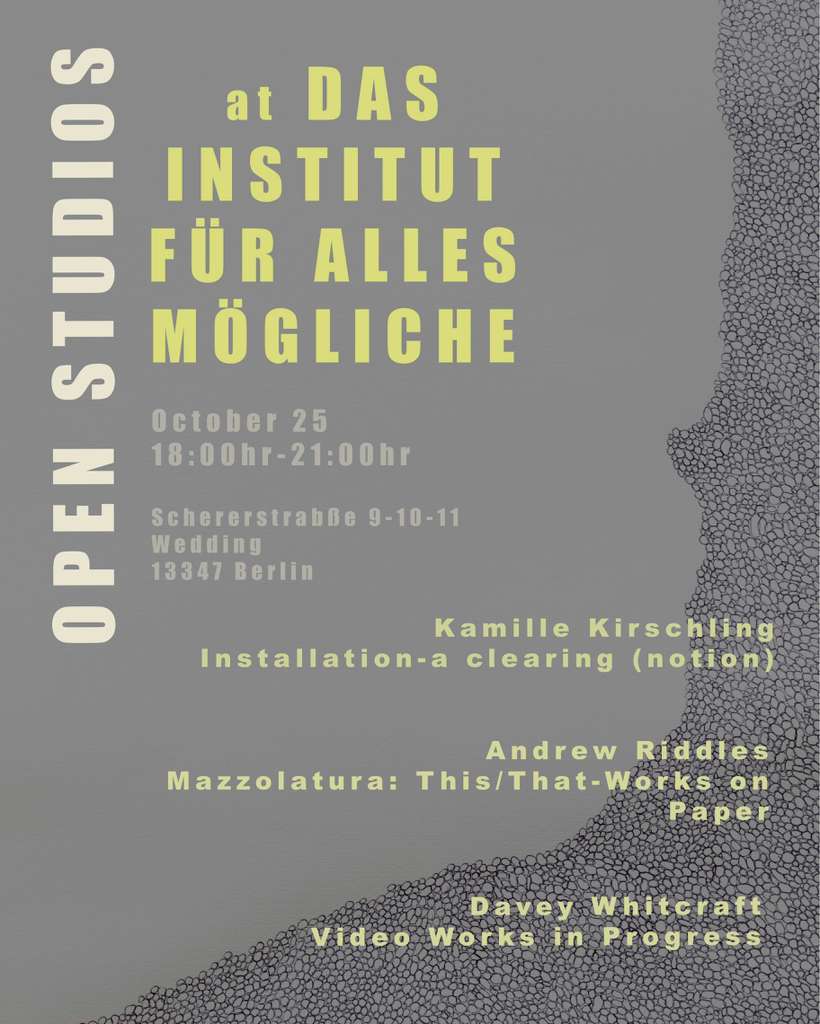
Kamille Kirschling | Davey Whitcraft | Andrew Riddles
Saturday, October 25th, 18:00-21:00
Zentrale/Niederlassung/Kanzlei Schererstraße 9/10/11 13347 Berlin | View on map
Kamille Kirschling: Installation – a clearing (notion)
A nearly empty room, on the verge of potential. The space is sparsely filled with lines that serve as references to a dense forest of 2×4 studs, revealing the skeletal framework of a house under construction. The partial outline of a completed home emerges, contrasting with the raw, unfinished surroundings. The floor is cloaked in a carpet, subtly suggesting a warm, finished interior that has been left untouched—habitation paused in time.
The image delicately explores the boundary between a mere house and a true home. It brings into focus the subtle imperfections and irregularities within the room—the cracks in the drywall, the unevenness of the floor, the slightly crooked lines—that emphasize the human touch and the ongoing process of creation. The journey from raw construction to lived-in comfort blurs the line between the built environment and personal history.
Davey Whitcraft – Works in Progress

Davey Whitcraft will share in-progress videos and sketches for a new work during the Open Studios. The project follows a group of people who dig underground, trying to connect with tree root networks. It continues ideas from his previous piece, ‘An Elemental Sleep: Six Failures’, exploring how materials, systems, and living forms overlap in time. Whitcraft works with video, installation, and environmental research, focusing on landscapes shaped by extraction and transformation.
www.daveywhitcraft.com
—
Andrew Riddles – Mazzolatura: This/That

Andrew Riddles is attending the residency program of das Institut für Alles Mögliche to complete his stage play Mazzolatura {FTP}, which explores Pope John Paul II’s tacit promotion of child abuse. In tandem, Riddles is producing visual art that both informs and reflects his writing, investigating the cognitive dissonance that allowed societies to overlook the Church’s protection of sexual predators.
His work also probes how such denials can become paradigms for events like the Genocide, and questions how we choose to memorialize mass violence—through monumental narratives, or representations of the individual tragedy within this.